History of Venezuela
 Venezuela
was the site of one of the first permanent Spanish settlements in South
America in 1522, and most of the territory eventually became part of the
viceroyalty of New Granada. Parts of what is now eastern Venezuela became
New Andalusia.
Venezuela
was the site of one of the first permanent Spanish settlements in South
America in 1522, and most of the territory eventually became part of the
viceroyalty of New Granada. Parts of what is now eastern Venezuela became
New Andalusia.
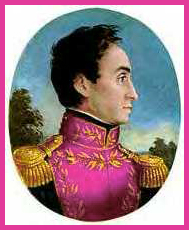
After several uprisings, the country declared independence from Spain on July 5th 1811 under the leadership of its greatest native son, Simón Bolívar. Nevertheless, full control over Venezuelan territory was achieved after Bolívar, with the help of General José Antonio Páez and especially the then General Grand Marshall Antonio José de Sucre, whose battle plan Bolívar chose to follow, won the Battle of Carabobo on June 24th 1821, and after José Prudencio Padilla won the Naval Battle of Lake Maracaibo on July 24th 1823. New Granada's congress gave Bolívar control of the Granadian army, he then led several countries to freedom and created a new republic called Colombia (also known as Great Colombia to differentiate it to the actual Republic of Colombia) consisting of what are now Colombia, Panama, Ecuador and Venezuela. He then led the army towards the south, liberating Peru and Bolivia (named after the Libertador) from the Spaniards. Antonio José de Sucre, who won many battles for Bolívar, was to become his natural successor, until he was murdered. Venezuela became, after the war of independence, along with Colombia and Ecuador, part of the Republic of Gran Colombia (República de Gran Colombia) until 1830, when the country separated through a rebellion led by Jose Antonio Páez and declared itself a sovereign republic. Páez became the first president of Venezuela.
Much of Venezuela's 19th- and early 20th-century history was characterized by political instability, political struggle and dictatorial rule. Following the death of Juan Vicente Gómez in 1935 and the demise of caudillismo (authoritarian oligarchical rule), democratic struggles eventually forced the military to withdraw from direct involvement in national politics in 1958. Since that year, Venezuela has enjoyed an unbroken tradition of democratic civilian rule.
Politics of Venezuela
The Venezuelan president is elected by vote, with direct and universal suffrage, and functions as both head of state and head of government. The term of office is six years, and a president may be re-elected to a single consecutive term. The president appoints the vice-president and decides the size and composition of the cabinet and makes appointments to it with the involvement of the legislature. The president can ask the legislature to reconsider portions of laws he finds objectionable, but a simple parliamentary majority can override these objections.
The unicameral Venezuelan parliament is the National Assembly or Asamblea Nacional. Its 167 deputies, of which three are reserved for indigenous peoples, serve five-year terms and may be re-elected for a maximum of two additional terms. They are elected by popular vote through a combination of party lists and single member constituencies. The highest judicial body is the Supreme Tribunal of Justice or Tribunal Supremo de Justicia, whose magistrates are elected by parliament for a single 12-year term. The National Electoral Council (Consejo Nacional Electoral, or CNE) is in charge of electoral processes; it is formed by five main directors elected by the National Assembly.
Venezuela was the first country in the world to abolish the death penalty, in 1863.
Source:
http://en.wikipedia.org/wiki/Venezuela