About Venezuela
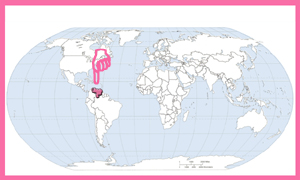 Venezuela
is a country on the northern tropical Caribbean coast of South America.
Venezuela borders Brazil to the south, Guyana to the east, and Colombia
to the west. North of the Venezuelan coast lie the islands of Aruba, the
Netherlands Antilles, and Trinidad and Tobago.
Venezuela
is a country on the northern tropical Caribbean coast of South America.
Venezuela borders Brazil to the south, Guyana to the east, and Colombia
to the west. North of the Venezuelan coast lie the islands of Aruba, the
Netherlands Antilles, and Trinidad and Tobago.
A former Spanish colony, Venezuela is a federal republic. Historically, Venezuela has had territorial disputes with Guyana, largely concerning the Essequibo area, and with Colombia concerning the Gulf of Venezuela (Gulf of Coquibacoa according to Colombia). This issue is not yet resolved. Today, Venezuela is known widely for its petroleum industry, the environmental diversity of its territory, and its sheer natural beauty. It has been claimed that Christopher Columbus was so enthralled by Venezuela's landscape, when arriving to its coast in 1498, that he referred to the land as Tierra de Gracia (Land of Grace), which has become the country’s nickname.
The name Venezuela is believed to have originated from the cartographer Amerigo Vespucci, who together with Alonso de Ojeda led a 1499 naval expedition along the northwestern coast (known today as the Gulf of Venezuela). On reaching the Guajira Peninsula, the crew observed the distinctive stilt villages (palafitos) that the indigenous Añu people had built over the water. This reminded Vespucci of the city of Venice ("Venezia" in Italian) and as a result the region was named Veneziela , which means Little Venice, and then it evolved to "Venezuela". On the other hand, the Spanish conquistador and geographer Martín Fernández de Enciso, a member of the same crew, says in his work Summa de Geografía that the above mentioned population was called Veneciuela, and that it was built on a large, plain rock. According to this theory, the name Venezuela could be a native word. Nevertheless, the first account remains by far the most popular and accepted version of the origin of the country's name.
Source:
http://en.wikipedia.org/wiki/Venezuela